Businesses in 2026 need more than a basic website. Customers expect fast digital experiences, personalized interactions, secure transactions, and easy access to services across devices. At the same time, businesses need technology that can integrate with their existing systems and adapt as they grow.
Unlike template-based websites or generic software, custom web applications are designed around specific business requirements. They can include customer portals, dashboards, booking systems, eCommerce platforms, internal tools, SaaS products, automation workflows, and integrations with third-party services.
For businesses looking for flexible website solutions, custom development provides a way to build technology around actual business processes rather than forcing those processes into the limitations of an off-the-shelf platform.
What Is Custom Web Application Development?
Custom web development is the process of planning, designing, developing, testing, and maintaining a web-based application according to a company’s specific requirements.
A standard website may primarily provide information about a business. A custom web application can go much further by allowing users to perform actions, manage information, communicate with systems, and complete business processes online.
For example, a company might require:
- A customer login and account portal
- Online booking and appointment management
- A custom eCommerce platform
- Employee dashboards
- Inventory management
- CRM integration
- Payment processing
- Real-time reporting
- AI-powered features
- Automated business workflows
The technology and architecture are selected according to the application’s goals, expected users, security requirements, and future growth.
Why Businesses Need Custom Web Development
The digital requirements of businesses continue to evolve. A website that worked several years ago may not provide the functionality, performance, or flexibility required today.
1. Designed Around Your Business
One of the biggest advantages of custom development is flexibility.
Instead of changing your business workflow to fit an existing application, developers can build features around your processes. This can help eliminate unnecessary functionality and create a more focused user experience.
2. Better Integration
Modern businesses often use multiple tools for CRM, accounting, marketing, payments, analytics, inventory, and customer support.
Custom web applications can connect these systems through APIs and integrations. This can reduce repetitive data entry and create smoother information flow between different platforms.
3. Scalability
Your application should be able to evolve with your company.
A properly planned custom application can be structured so that new features, users, integrations, and business modules can be introduced over time. This makes scalability an important consideration from the beginning of the project.
4. Security and Control
Security should be considered throughout the development lifecycle rather than added after an application has been built.
Custom applications can implement role-based access, authentication, secure APIs, encryption, logging, backups, and other security controls based on the application’s requirements.
5. Improved User Experience
Customers and employees expect digital products to be fast, intuitive, mobile-friendly, and easy to navigate.
Custom development allows designers and developers to build workflows around specific user groups rather than relying entirely on generic templates.
Custom Web Development in Vancouver
Businesses searching for custom web development in Vancouver operate in a competitive digital environment where website performance, mobile usability, SEO, accessibility, security, and integrations can all affect the effectiveness of a digital product.
Vancouver businesses may need anything from a high-performance marketing website to a sophisticated customer portal or business management application. Local web development providers commonly offer custom websites, web applications, integrations, and ongoing maintenance for businesses across Vancouver and British Columbia.
For companies evaluating development partners, important considerations include technical expertise, communication, project methodology, technology choices, security practices, and post-launch support.
A good development project should begin with business requirements rather than immediately choosing a framework or programming language.
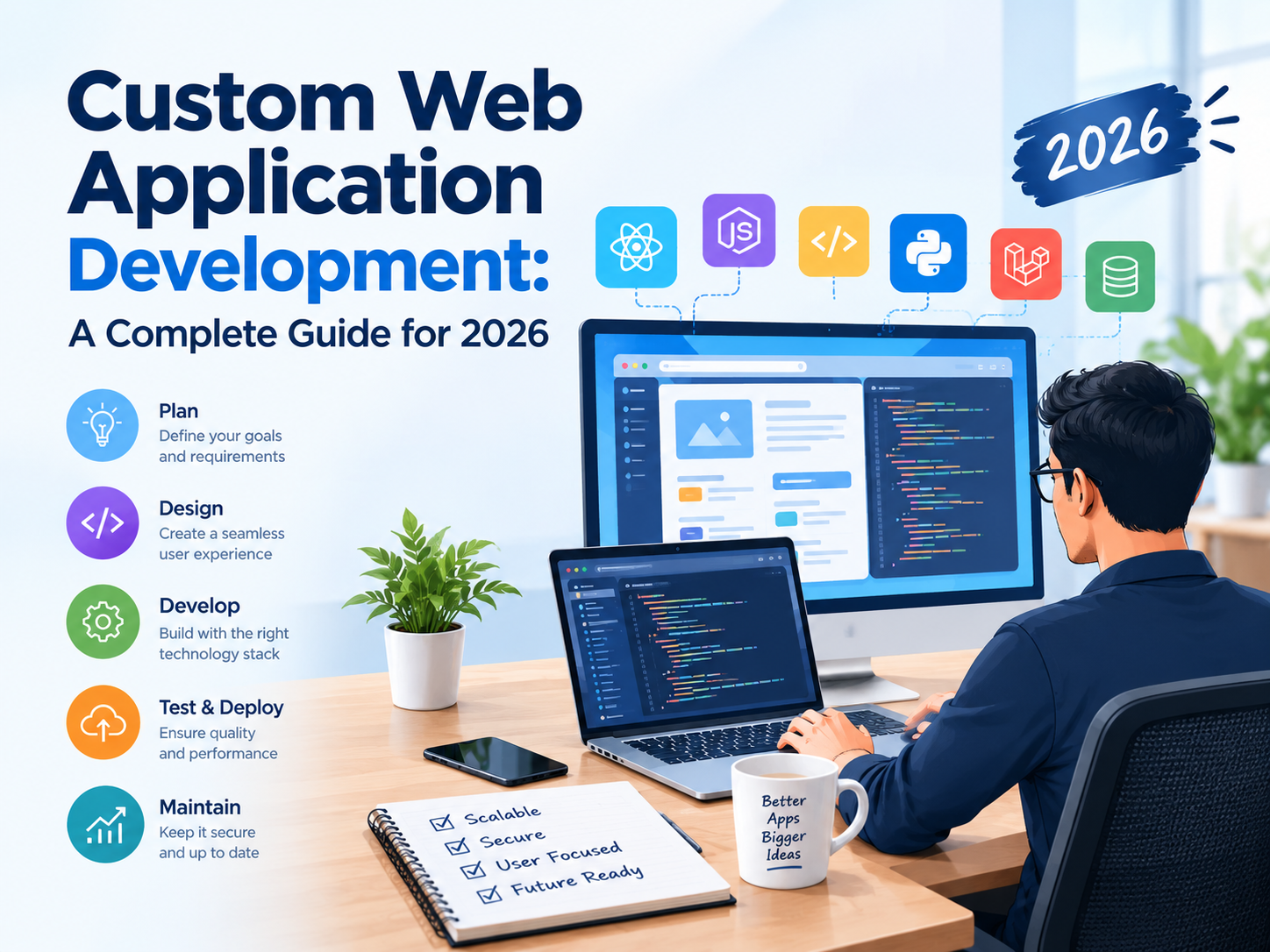
Custom Web Application Development Process
A successful application usually follows a structured development process.
1. Discovery and Requirements
The first stage is understanding the business problem. The development team identifies target users, business objectives, required features, integrations, workflows, technical requirements, and potential challenges.
Clear requirements help prevent scope confusion later in the project.
2. UI/UX Design
The next step is designing the user experience.
Wireframes and prototypes help establish navigation, page layouts, user journeys, and interactions before development begins.
A user-focused design should work effectively across desktops, tablets, and mobile devices.
3. Technology and Architecture
Developers select the technology stack based on the application’s requirements.
Depending on the project, this may involve technologies such as React, Angular, Vue, Node.js, PHP, .NET, Python, Laravel, databases, cloud services, and third-party APIs.
The goal should not simply be to use the newest technology. The technology should be appropriate for the application’s performance, security, maintenance, and scalability requirements.
4. Development
Developers then build the frontend, backend, database structure, APIs, authentication, integrations, and required functionality.
Agile development can allow teams to deliver functionality in smaller iterations, collect feedback, and adjust priorities throughout the project.
5. Testing and Quality Assurance
Before launch, the application should be thoroughly tested.
Testing may include:
- Functional testing
- Browser and device testing
- Performance testing
- Security testing
- API testing
- Usability testing
- Integration testing
Testing helps identify problems before they affect customers or employees.
6. Deployment and Maintenance
After approval, the application is deployed to its production environment.
However, development does not necessarily end at launch. Applications require monitoring, security updates, bug fixes, performance improvements, backups, and feature enhancements as business requirements change.
How Custom Website Solutions Help Businesses
Modern website solutions should contribute to measurable business objectives rather than simply provide an online presence.
A custom solution can help businesses:
- Automate repetitive processes
- Improve customer communication
- Centralize business information
- Connect multiple software platforms
- Provide personalized customer experiences
- Improve internal productivity
- Support new business models
- Build scalable digital products
For example, a service company could combine customer registration, appointment scheduling, online payments, notifications, and reporting into one platform instead of requiring customers and employees to use several disconnected systems.
Custom Development vs. Off-the-Shelf Software
Off-the-shelf software can be useful when a business has common requirements and wants to launch quickly.
However, customization may become difficult when the application needs unusual workflows, complex integrations, or specialized functionality.
Custom development generally provides greater control over:
- Features
- User experience
- Integrations
- Data structures
- Security architecture
- Scalability
- Future development
The right approach depends on the business problem, budget, timeline, and technical requirements.
Best Practices for Custom Web Development
Businesses planning a custom project should consider several best practices.
Define measurable goals: Know what the application is expected to accomplish.
Start with an MVP: Build the most important functionality first and expand based on user feedback.
Prioritize security: Consider authentication, authorization, data protection, secure APIs, backups, and monitoring from the beginning.
Design for mobile users: Responsive experiences are essential for modern web applications.
Plan integrations carefully: Document APIs, data flows, error handling, and dependencies.
Think about maintenance: Select technologies and architecture that your team can realistically support over the long term.
Measure performance: Monitor loading times, errors, uptime, conversions, and other relevant KPIs after launch.
How Much Does Custom Web Development Cost?
The cost of custom web development varies significantly from one project to another.
A simple business portal may require considerably less development than a multi-user SaaS platform with payment processing, real-time data, complex integrations, and advanced security requirements.
Factors that influence cost include:
- Number of features
- Design complexity
- Number of user roles
- Integrations
- Technology stack
- Security requirements
- Third-party services
- Development timeline
- Ongoing maintenance
Rather than choosing a development partner solely on the lowest initial price, businesses should consider the application’s total cost of ownership and long-term requirements.
The Future of Custom Web Development
In 2026, custom web development is increasingly connected with cloud computing, automation, AI, APIs, analytics, and modern frontend technologies.
Businesses can use these technologies to create smarter workflows and more personalized digital experiences. However, technology should serve a clear business purpose. Adding features simply because they are popular can increase complexity without necessarily improving the product.
The strongest custom development projects begin with a business problem and then select the technology needed to solve it.
Conclusion
Custom web development gives businesses the flexibility to create digital products around their unique requirements. From customer portals and eCommerce platforms to internal dashboards, SaaS applications, and automated workflows, custom applications can support both current operations and future growth.
For businesses considering custom web development in Vancouver, the key is to choose a development approach that balances functionality, user experience, performance, security, scalability, and long-term maintenance.
With the right planning and development partner, a custom application can become more than a website, it can become an important part of the way a business operates, serves customers, and grows digitally.
Ready to Build a Custom Web Application?
If your business needs a tailored digital product, explore custom development solutions from Programming Expertz and discuss your requirements with a development team that can help turn your idea into a scalable web application.