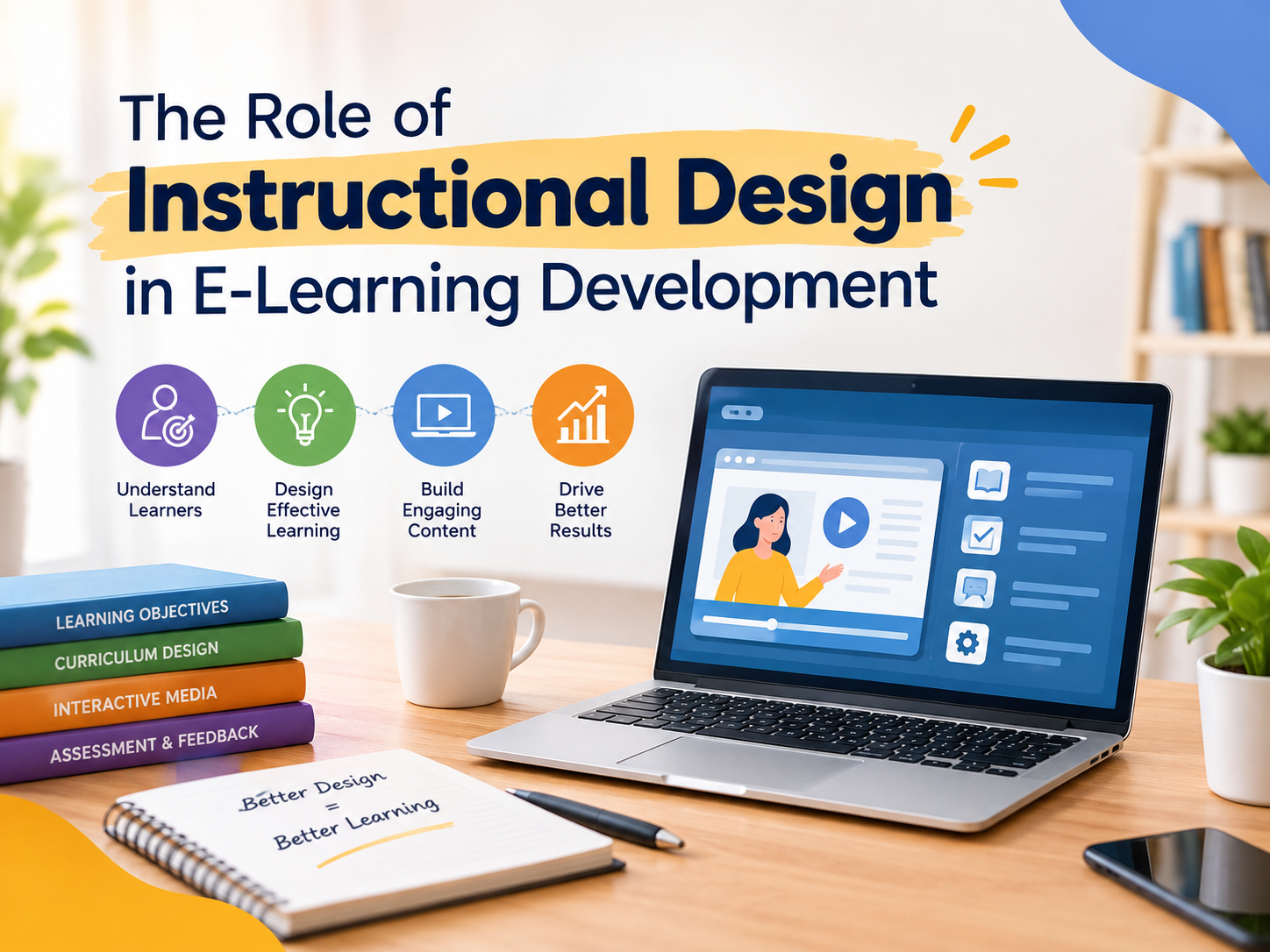
Creating an online course is more than putting information on a screen. A successful e-learning experience needs to be clear, engaging, interactive, and designed around the needs of its learners. This is where instructional design plays an important role.
Instructional design provides a structured approach to planning and developing learning experiences. It helps organizations turn complex information into useful and engaging training content that learners can understand and apply.
For businesses, educational institutions, and training providers, effective e-learning development combines instructional strategy, technology, content, and learner experience to create courses that support specific learning goals.
What Is E-Learning Development?
If you are wondering what is e-learning development, it is the process of creating digital learning experiences that can be delivered through computers, tablets, smartphones, or learning management systems (LMS).
E-learning development can include several elements, such as:
- Online courses and training modules
- Interactive quizzes and assessments
- Videos and animations
- Software simulations
- Scenario-based learning
- Interactive presentations
- Learning management system integration
- Mobile-friendly learning content
The development process usually starts with understanding the learning objectives and target audience. The content is then planned, designed, developed, tested, and prepared for delivery.
Instructional design connects these different stages and ensures that the final course is not simply informative but actually supports learning.
What Is Instructional Design?
Instructional design is the process of planning learning experiences around specific objectives and learner requirements.
An instructional designer considers questions such as:
- Who are the learners?
- What do they already know?
- What skills do they need to develop?
- What should they be able to do after completing the course?
- Which learning activities will help them understand the subject?
- How should their knowledge and performance be assessed?
By answering these questions before development begins, organizations can create more focused and useful e-learning courses.
Why Instructional Design Matters in E-Learning Development
1. Creates Clear Learning Objectives
A good course should have a clear purpose. Instructional design helps define what learners should know or be able to do after completing a course.
For example, instead of simply teaching employees about a software application, an e-learning course can be designed around specific tasks they need to perform using that software.
Clear objectives also make it easier to create relevant activities and assessments.
2. Makes Complex Information Easier to Understand
Some subjects can be difficult to explain through text alone. Instructional design helps break complex information into smaller and more manageable sections.
Content can be presented through a combination of text, graphics, videos, animations, demonstrations, and interactive activities.
This approach can make learning easier to follow while helping learners focus on the information that matters most.
3. Improves Learner Engagement
One of the challenges of online learning is maintaining learner attention. Simply presenting long blocks of text may not provide enough interaction.
Instructional design can introduce activities such as quizzes, simulations, branching scenarios, drag-and-drop exercises, and knowledge checks.
For example, scenario-based learning can place learners in a realistic situation and allow them to choose how they would respond. This gives learners an opportunity to apply information instead of simply reading about it.
Programming Expertz also provides different levels of e-learning experiences, including basic interactive learning, scenario-based learning, and advanced interactive and simulation-based learning.
4. Supports Practical Learning Through Simulations
Some skills are better learned through practice. Software simulations are particularly useful when learners need to understand a system, application, or workflow.
A simulation can allow learners to:
- Watch how a task is completed
- Practice the task themselves
- Receive guidance and feedback
- Complete the task independently
- Demonstrate their understanding
This type of approach can be useful for software training, employee onboarding, system training, and process-based learning.
Programming Expertz offers simulation-based learning approaches such as demonstration, practice, and assessment modes.
5. Creates Personalized Learning Experiences
Different learners may have different levels of knowledge and experience. Instructional design can account for these differences by creating learning paths that are appropriate for the target audience.
For example, an introductory module can provide basic information for new learners, while experienced users can move directly to advanced topics or practical activities.
Learning can also be divided into smaller modules so that learners can complete content according to their schedule.
Instructional Design Models Used in E-Learning
Instructional designers can use different models to plan and develop courses. One commonly used approach is the ADDIE model:
Analysis: Understand the learners, business requirements, existing knowledge, and learning objectives.
Design: Plan the course structure, activities, assessments, and learning strategy.
Development: Create the actual content, visuals, interactions, simulations, and other course elements.
Implementation: Deliver the course through an LMS or another suitable platform.
Evaluation: Review learner performance, feedback, and course effectiveness to identify areas for improvement.
Following a structured process can reduce unnecessary content and keep development focused on the intended learning outcomes.
Choosing the Right Tools for E-Learning Development
Technology is another important part of modern e-learning development. The right authoring tool depends on the type of course, level of interaction, target devices, and delivery requirements.
Popular tools can support different types of learning experiences, including interactive courses, software simulations, video-based training, responsive learning, quizzes, and scenario-based activities.
Programming Expertz works with tools including Adobe Captivate, Articulate Storyline 360, Articulate Rise 360, Lectora, Camtasia, and other e-learning technologies. The company also supports LMS platforms such as Moodle, Blackboard, Adobe Connect, and SumTotal.
The Role of Instructional Design in E-Learning Development in Vancouver
Organizations looking for e-learning development in Vancouver may have different training requirements depending on their industry, workforce, and learning goals.
For example, a business may need employee onboarding courses, compliance training, software training, or product education. Educational organizations may require interactive online lessons, assessments, or learning management solutions.
Instructional design helps ensure that the development process starts with these requirements rather than focusing only on technology.
A well-planned course can combine instructional strategies with interactive content, simulations, multimedia, and LMS functionality to create a learning experience that is relevant to its audience.
How Instructional Design Improves the Overall Learning Experience
Good instructional design brings together several elements of e-learning development. It determines what learners need to learn, how information should be presented, which activities can reinforce the content, and how learning should be evaluated.
This can result in courses that are:
- Easier to navigate
- More engaging
- Focused on specific objectives
- Interactive and practical
- Accessible across different devices
- Easier to measure and improve
The goal is not to add interaction simply for the sake of making a course look attractive. Every activity, graphic, simulation, or assessment should have a clear purpose.
Conclusion
Instructional design is an essential part of successful e-learning development. It provides the structure needed to transform information into meaningful learning experiences.
From defining learning objectives and organizing content to creating scenarios, simulations, assessments, and interactive activities, instructional design helps ensure that technology supports learning rather than becoming a distraction.
For organizations looking for e-learning development in Vancouver, a structured approach can help turn training requirements into scalable digital learning solutions that support both learners and business objectives.
FAQs
Q1. What is the role of instructional design in e-learning development?
Instructional design helps structure e-learning content around clear learning objectives, learner needs, interactive activities, assessments, and practical outcomes.
Q2. Why is instructional design important for online courses?
It makes online courses more organized, engaging, and easier to understand by combining appropriate content, learning strategies, multimedia, and assessments.
Q3. What tools are used in e-learning development?
E-learning development can use tools such as Articulate Storyline, Articulate Rise, Adobe Captivate, Lectora, and Camtasia to create interactive courses, simulations, videos, and assessments.
Q4. How can businesses benefit from e-learning development in Vancouver?
Businesses can use e-learning development in Vancouver to create customized employee training, onboarding, software training, compliance courses, and interactive learning programs that can be accessed online.